A continual-learning agent whose skill graph develops through mechanisms borrowed from neural-network training.
1Université de Montréal · 2Mila · 3Microsoft Research · 4Canada CIFAR AI Chair *Equal advising
Embodied agents must continually acquire, refine, and reuse a growing repertoire of skills. The central challenge isn't just learning skills, it's continually reorganizing and improving them in dynamic, open-ended environments, without forgetting what came before.
Today's LLM agents represent skills either as flat libraries or static graphs. Both lack a unified framework for credit assignment and structural reorganization as new tasks arrive.
Skills indexed by similarity. Voyager-style. Cannot compose; new tasks don't decompose into existing skills.
Hand-authored library, fixed at design time. ODYSSEY-style (183 skills). No learning, reuses within its fixed repertoire, but cannot grow and adapt to novel tasks.
Skills as programs in a directed graph that continually reorganizes through symbolic updates as the agent learns.
We've mastered learning in continuous, parameterized systems. What if we applied the same powerful optimization principles to a network of discrete, symbolic programs?
credit flows along the activation path
REFLECT diagnoses each skill on the trace
freeze converged layers, keep new ones plastic
V(s) gates updates per skill
restructure topology to improve capacity
merge, extract, prune skills under rollback
The analogy is partial (PSN works over discrete programs and binary success signals), but the algorithmic structure of NN training transfers, and yields testable predictions (see §4 propagation depth, §5 retention & oscillation, §6 stair-step structural growth).
When a multi-skill plan fails, the question isn't which skill was responsible: backprop doesn't compute one gradient, it computes one per parameter along the activation path. REFLECT does the symbolic analogue: it propagates failure feedback recursively along the executed invocation trace, assigning a per-skill diagnostic to every skill the trace visited.
Two phases. Phase I propagates feedback top-down
(like PyTorch's loss.backward()): for each visited skill, the parent's blame
decomposes into a local edit proposal (gradient) gs plus
child feedback signals {fs'} that flow further down.
Phase II applies the per-skill edit, leaves first
(like optimizer.step()).
The prediction the analogy makes, and our data confirms. If REFLECT really is chain-rule-like credit assignment with per-skill gradients, the propagation depth should scale with how noisy the per-skill diagnosis is. A weaker code-generator produces noisier per-skill blame, so the recursion travels deeper before residual feedback drops below noise floor. GPT-5-mini converges in 2.7 reasoning steps; Qwen3-Coder-Next needs 5.0 (about 2× deeper). A heuristic-localization framing of REFLECT (one most-visible skill per call) doesn't predict this scaling. Chain-rule does.
Once a skill has converged, additional edit on it can be risky since REFLECT's gradient is itself noisy (see §7). Downstream failure can backprop up the call chain and "fix" a working ancestor into breaking. PSN closes this trap with per-skill update probabilities, a learning-rate schedule that freezes mature skills while keeping immature ones plastic.
Each skill carries a reliability score, a smoothed success rate adjusted by how uncertain we are about it. Mature skills (high reliability) get chosen for update only rarely; immature ones are updated almost every call.
The prediction the analogy makes. If gating freezes converged skills, removing it should produce cumulative-SR oscillation when downstream failures perturb mature skills. Without gating (orange), the curve dips when a new harder task arrives. With gating (blue), mature skills stop receiving updates, the curve climbs and stays climbed.
Catastrophic forgetting in flat libraries. Re-evaluated after each new task, mature skills retain function (50–100%) under PSN; Voyager's flat library degrades to zero on diamond pickaxe. Stability without sacrificing plasticity.
As the agent learns, the network accumulates redundancies: duplicates, overlapping coverage, and missing abstractions. PSN restructures it through five canonical rewrite cases. But a rewrite that looks safe at the surface (a merge of two seemingly-identical siblings, a parameter generalization across cases) can silently change behavior, so every proposal passes through a two-stage safety gate before it touches the network.

Two skills share an overlapping sub-operation → extract a shared parent skill; both call it. The shared sub-operation is now a reusable building block.

A composite skill duplicates the logic of an existing subskill → rewire to call it. Duplicated blocks are replaced with calls to existing skills.

One skill is a strict specialization of another (e.g. mineOakLogs(num) ⊂ mineLogs(OAK, num)) → absorb into a parameterized parent.

Multiple sibling skills imply a missing abstraction → introduce a shared parent and rewrite each sibling as a thin wrapper.

Two skills are functionally identical up to naming → canonical merge plus link rewire.
Every refactor proposal flows through two gates:
The prediction the analogy makes. If refactor really is the architectural mechanism, R_struct should rise in stair-stepped jumps after refactor events, not smoothly.
Unlike a calculus-defined gradient, REFLECT's gradient is an LLM output: noisy by construction. The architectural question isn't how to make it noise-free (it can't be), but how the surrounding system makes REFLECT-driven learning converge despite that noise.
The LLM's world-knowledge fails in three ways: it may be absent (the fact never made it into the pretraining corpus), un-recalled (the fact is in the weights but the prompt fails to surface it), or hallucinated (the LLM confidently generates a plausible-sounding but false fact).
The raw_iron block has been in vanilla MC since version 1.17 (well before Qwen3's pretraining cutoff). The model has the data but confidently denies it: un-recalled + hallucinated.
PSN's fix: knowledge-augmented REFLECT. A small Minecraft-fact knowledge index is retrieved into Phase I REFLECT's prompt. Verified facts in context bypass all three modes at once: no recall needed, concrete claims to override hallucinations, and missing knowledge supplied. This is a knowledge-side mitigation, not architectural: REFLECT's structure doesn't change, we just feed it better context.
The LLM's causal reasoning fails in three ways: it may anchor on salience (latching onto the most prominent context item as the cause), fabricate plausibility (constructing a coherent-sounding story without grounding it in evidence), or operate from a signal-starved trace (the env didn't surface the actual cause clearly enough to reason from).
Qwen3 anchored on the salient cue (lava) and fabricated a physics-sounding story to bridge the gap: anchor + fabricate + starved trace.
PSN's fix: env-validated iteration. We don't try to make individual REFLECT calls reason correctly. PSN accepts noisy reasoning and relies on the iteration loop: each candidate skill re-executes in real Minecraft, correct optimizations survive the effect check, noisy reasoning gets filtered by the next iteration's fresh env feedback. Reasoning-layer noise tolerance is architectural at the loop level, not at the per-REFLECT level.
The LLM's code-generation interface fails in three ways: it may fabricate APIs (referencing functions that don't exist), misuse contracts (calling real APIs with wrong argument shapes, e.g., string vs id list, missing required parameters), or mimic surface patterns (copying syntactic patterns from prompt examples without synthesizing actual gameplay logic).
bot.chat('/give bot diamond 3')" — Qwen3, copied verbatim from a curriculum example instead of synthesizing gameplaybot.chat is a real API and the call signature is correct, so this is pure surface mimicry from a curriculum example that included the /give chat-command pattern.
PSN's fix: static validation + cleaned context. A static reference checker (Babel parse + symbol resolution) catches fabricated APIs before execution; API-contract docs in the action-agent prompt teach correct call shapes; curriculum prompts are cleaned of cheat-command patterns to remove the mimicry templates. In a production-prompt replay study (n=20), the bug rate dropped from 65% → 35%. The reference-checker is architectural (pre-execution gate); the rest is context shaping.
Framework-level — env-validated iteration. We accept noise; the
env filters it. The skill update rule is si+1 = si + δsi
where δsi = REFLECT(si, env_feedbacki). Each
si re-executes in real Minecraft; correct optimizations survive
(they pass the effect check), noise is filtered (failed executions feed the next REFLECT),
and the loop converges when si solves the task. Noise tolerance
comes from the iterative loop, not from individual REFLECT calls being trustworthy.
Layer-targeted assists. Where possible, PSN gives REFLECT layer-specific help so the loop has less work to do: better facts (Knowledge layer, knowledge-augmented REFLECT), explicit API contracts and cleaned curriculum context (Interface layer, context shaping), and a pre-execution validation gate for fabricated APIs (Interface layer, architectural). Reasoning has no skill-structure-level assist, its noise tolerance comes entirely from the framework-level loop above.
Most striking: Knowledge layer +33pp on Qwen3, only +2pp on GPT-5-mini: the fix is a weak-LLM corrigendum, not architectural. Interface-layer validation is architectural and applies across LLMs (production-prompt replay bug rate 65% → 35%).
A skill library that grows but is never reused is a code dump, not a learning system. Library size matters, but the more telling metric is how many skills get reused.
Rstruct = fraction of skills with fan-in > 1. Rises from 0 (every skill a leaf) toward an asymptote where most skills are reused by multiple parents. Across 6 Qwen3 runs, Rstruct reaches ≈ 0.094 ± 0.045; on GPT-5-mini, paper-side runs reach ≈ 0.4.
Three observables consistently point at LLM strength as the underlying axis: REFLECT depth (2.7 vs 5.0 in §4), hallucination rate (0% vs 33% in §7), Rstruct asymptote (0.4 vs 0.094 here). Weaker LLM → noisier REFLECT → flatter network. The architecture absorbs as much as it can; the rest leaves a measurable imprint on the topology.
Structural reuse. The run grows a hub-and-spoke
topology: a few setup/utility skills (setupCraftingTable,
ensureResource) become repeat-use hubs depended on by 8–9 other learned
skills. This is the static graph property: how many skills could reuse a
given one.
Execution reuse. How often each skill was actually invoked during the run. Structural reuse and execution reuse don't perfectly align: some high-fan-in skills are rarely called; some are heavily called even with modest fan-in. Both views matter: the first is architectural reusability, the second is operational reuse.
PSN's library grows hubs autonomously, even on the same LLM (Qwen3-Coder-Next-FP8) and the same task curriculum. The chart below shows the per-run fan-in distribution averaged across 6 paired runs each.
Average per-run distribution of skill fan-in across 6 paired runs each. PSN consistently produces ~7 skills per run with fan-in ≥ 1 (some reaching fan-in 3+); Voyager's library has every skill at fan-in 0 by architectural constraint.
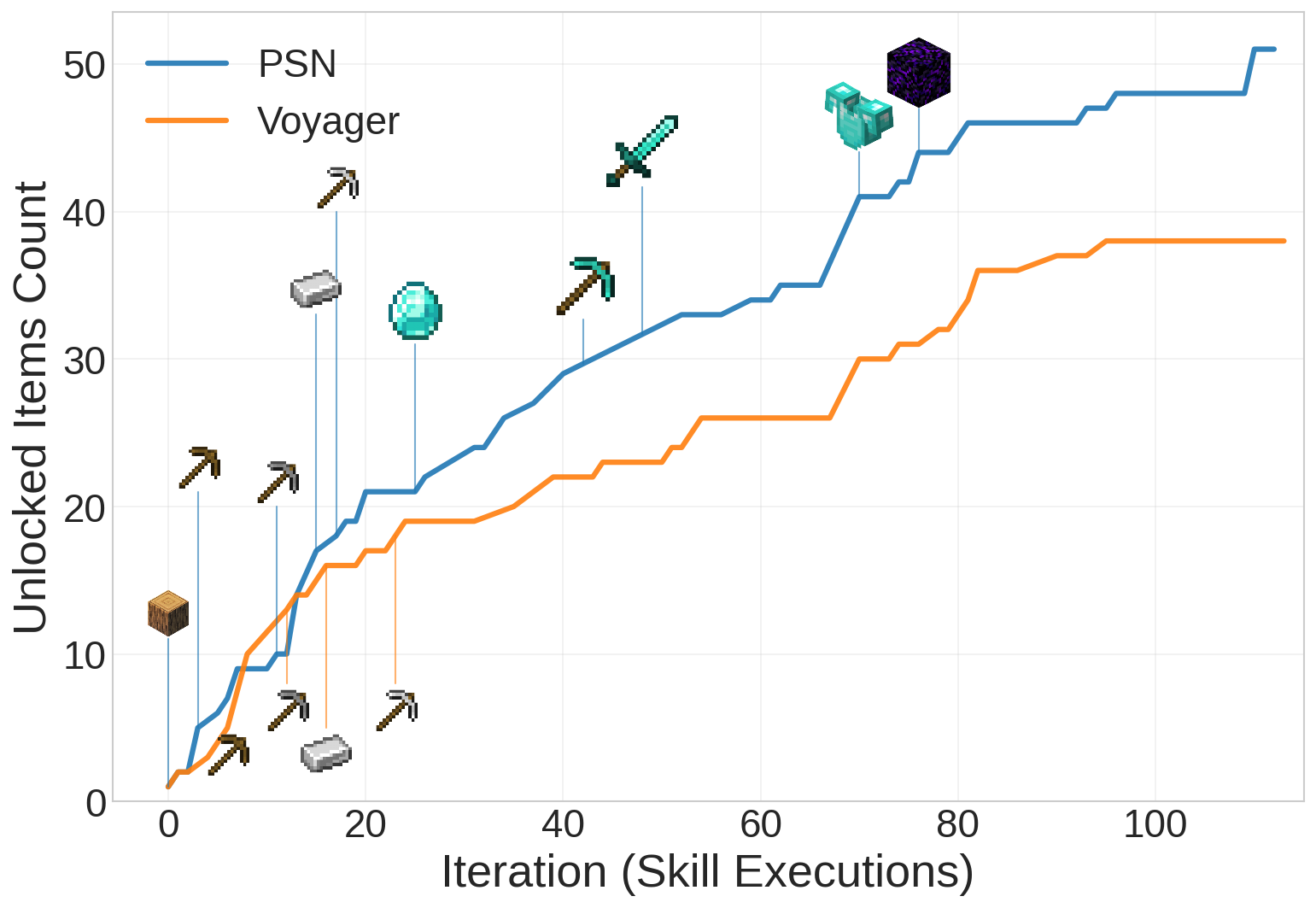
GPT-5-mini. PSN unlocks the diamond tools in 32 ± 10 iterations across 6/6 runs; Voyager 2/6.
Crafter cumulative reward. PSN sustains higher reward than Voyager (~12 vs ~8) and dominates planning-only baselines (ReAct, Reflexion).
Qwen3-Coder-Next-FP8 (3B active / 80B total MoE, 6×6 evaluation). PSN reaches the diamond tools in 44 ± 13 iterations across 6/6 runs; Voyager 1/6.
Skill retention. PSN preserves earlier skills near 100%; Voyager's flat library decays from 86% to 0% across the tech tree.
A real PSN run on GPT-5-mini. Each node is a JavaScript skill; edges are parent → child reuse links; node color encodes norm V. Low-norm-V nodes are skills whose uncertainty term still exceeds estimated success, i.e., legitimate plastic skills. Click any node for code, optimization history, preconditions, and effects.
Loading skill graph data…